
Voices/ January 2026
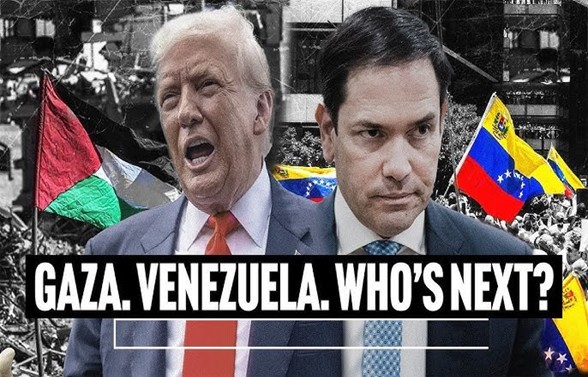
The U.S. abduction of Venezuelan President Nicolás Maduro and his wife, on 3 January 2026, following overnight strikes on Caracas and the coastal corridor, is not simply an escalation in a long dispute. It is a declaration, made through aggression, that sovereignty in the Western Hemisphere is a mirage subject to U.S. intervention and that international law is an instrument reserved for adversaries and weak states, not an obligation that applies to the empire or great powers.
While the U.S. framed the action as “law enforcement,” in practice, it resembled a military raid, a reality underscored by the White House’s own words. Donald Trump called the operation “extremely successful” and said the United States would “run the country” until a “safe, proper, and judicious transition.” He warned Venezuelan leaders that “what happened to Maduro can happen to them,” adding that he was not afraid of putting “boots on the ground.”
Most revealing was Trump’s decision to tie the action openly to oil. He promised that U.S. companies would enter Venezuela to “fix the badly broken infrastructure” and “start making money,” while brazenly claiming the country had “stolen” oil the United States had “built” with “American talent, drive, and skill,” calling it “one of the largest thefts of American property” in U.S. history. This language, drawn directly from Trump’s own description of the operation, belongs to the arrogant vocabulary of conquest rather than that of legality and justice.
Empire and the Monroe Doctrine as an Operating System of Control:
To understand Trump’s actions in Venezuela, one must situate them within a larger pattern of imperialism. Declared in 1823 by the fifth U.S. president, James Monroe, the Monroe Doctrine sought to establish the Western Hemisphere as a U.S. sphere of control. Initially framed as a warning to European powers to end their military presence in the region, it served to consolidate U.S. hegemony. Over time, it evolved into a doctrine of hemispheric enforcement: the United States would determine which governments were deemed “legitimate,” which were labeled “dangerous” and subject to sanctioning or replacement and which resources were considered “strategic” and therefore could be acquired by hook or crook.
The list is familiar because the pattern is. Iran (1953), Guatemala (1954), Brazil (1964), Chile (1973), Grenada (1983), Nicaragua during the Contra era (1980s), Haiti (1994), and Venezuela itself in the failed 2002 coup against its president at the time, Hugo Chávez are not isolated episodes. They are variations on a single proposition. When a government obstructs U.S. hegemony or strategic and economic priorities, instability becomes policy, and “democracy,” “anti-communism,” “counter-terrorism,” or “war on drugs” become the slogan of the day and are used to compel coercion.
What is new in January 2026 is not intent, but brazenness. Earlier interventions relied on deniability in the form of proxies, covert funding, and “advisers.” Here, the U.S. president openly embraced the logic of domination, presuming the world would be cowed and shaken by the visible display of America’s brute power.
Oil, Sanctions, and the Economics of Regime Change:
Venezuela sits atop more than 300 billion barrels of oil, the largest proven crude reserves in the world. That fact has never been morally neutral in an imperial system that treats energy as power. But it’s not just about oil. Venezuela’s southern mining belt, particularly around the Orinoco region, is rich in gold extraction and other precious metals. With more than 8,000 tonnes of gold resources, the country holds one of the largest gold endowments in the world. That matters because interventions sold as “anti-narcotics” or “anti-corruption” often carry a hidden purpose, in this case handing Trump and the heads of multinational corporations the power to decide who controls concessions, who commands trading routes and who gets to monetize what lies beneath the ground.
Venezuela also holds billions of tonnes of iron ore along with significant deposits of rare earth elements, nickel, copper and phosphates. These resources are critical inputs for modern technology and industrial production including steel, which is essential for manufacturing military hardware. In geopolitical competition, control of heavy-industry resources often determines the balance of power.
In the weeks and months preceding the attack, the United States tightened the screws in ways that reveal strategic purpose. In December 2025, it imposed a naval blockade that disrupted tanker traffic, seized cargoes, and cut oil exports in half, from about 900,000 barrels per day in November. In December, a cyberattack disrupted the operation of the Venezuelan state-owned oil company, PDVSA, and forced manual workarounds. What Washington demonstrated was not simply that sanctions inflict harm, but that sanctions, blockades, seizures, and “law enforcement” narratives are deployed as preparatory fires for regime change.
Around this time, China entered the equation as Venezuela’s oil exports increasingly shifted toward Asian markets beyond Washington’s control. In November 2025, China received about 80 percent of Venezuela’s crude exports, or about 746,000 barrels per day, while shipments to the U.S., routed through Chevron-linked channels, rose to about 150,000 barrels per day. In other words, Venezuela’s oil was not simply “under Maduro.” It was increasingly oriented toward Asia, a shift that, in an era of strategic competition, Washington treated as a geopolitical offense.
What Washington has sought to reverse is not only where Venezuela’s oil flows, but what that oil has been used to build at home. The political trajectory that the United States has sought to reverse since the late 1990s cannot be understood without reference to the Bolivarian Revolution and the social transformations it produced. Following Hugo Chávez’s election in 1998, Venezuela redirected oil revenues toward large-scale social programs designed to address decades of extreme inequality. Between 2003 and 2012, poverty was cut by more than half, extreme poverty fell sharply, and access to healthcare, education, housing, and food subsidies expanded dramatically, particularly in historically marginalized communities. Millions of Venezuelans received free primary healthcare through the Barrio Adentro program, literacy campaigns reduced illiteracy rates to near zero by UNESCO standards, and public university enrollment more than doubled. These gains were financed largely through state control of the oil sector and the deliberate redistribution of public resources.
It was precisely this model that U.S. policy sought to dismantle. Beginning with targeted financial measures in the mid-2000s and escalating after 2015 into sweeping oil, banking, and trade sanctions after 2015, U.S. coercive measures severely constrained Venezuela’s ability to import food, medicine, spare parts, and refinery equipment, while cutting off access to international credit markets. Even a U.S. government watchdog, the Government Accountability Office, acknowledged that oil sanctions, particularly those targeting PDVSA, accelerated economic contraction by severing the state’s primary revenue stream. The humanitarian deterioration that followed was not the cause of the sanctions but their consequence: a deliberate reversal of social gains through externally imposed economic strangulation, aimed not at reforming governance but at forcing regime collapse by making the existing system economically unviable.
The Collapse of Legal Pretense:
After the successful abduction, U.S. Secretary of State Marco Rubio, who has been pushing for regime change in Venezuela for months, described the attack as a “law enforcement” operation, Trump then claimed that Rubio had spoken with Venezuela’s Vice President Delcy Rodríguez, who, he surprisingly claimed, would support U.S. efforts.
On the Venezuelan side, however, the first official response was a basic demand that exposes the nature of the illegal act. Vice President Rodríguez confirmed Maduro’s whereabouts were unknown and demanded the United States provide proof of life. She then declared a state of emergency and issued a statement that named the strategic goal of the illegal U.S. attack, “to seize Venezuela’s strategic resources, particularly its oil and minerals,” and to “forcibly break the political independence of the nation.”
In the region and around the world, many countries condemned the U.S. operation, including Mexico, Brazil, and Colombia in the Western Hemisphere. In a post on X, the Brazilian President warned: “Attacking other countries, in flagrant violation of international law, is the first step towards a world of violence, chaos and instability, where the law of the strongest prevails over multilateralism.” He called on the international community to “respond vigorously” to the U.S. actions through the United Nations. China, whose special envoy for Latin America was in Caracas for meetings with Maduro, said it was “deeply shocked and strongly condemns the U.S. for recklessly using force against a sovereign state and targeting its president.”
That is why the U.S.’s insistence that this abduction was simply “law enforcement” is not just unconvincing, it’s politically revealing. A U.S. indictment of Maduro, unsealed in the wake of the military raid, is not evidence of criminal wrongdoing but rather a stamp placed after the fact to normalize what the U.S. empire had done.
And while Trump claimed the U.S. would now run Venezuela, his own State Department issued a warning that it could not help American citizens who may be stranded in the country.
Gaza, Ukraine, and Selective Legality as Doctrine:
Venezuela cannot be understood in isolation from Gaza, which has a global litmus test for lawfulness in international politics. While Washington framed its actions against Caracas as “law enforcement,” it spent the past two years politically shielding the Zionist regime politically, arming it militarily, and undermining any effort at accountability for its many crimes.
In the South Africa case under the Genocide Convention, the International Court of Justice issued provisional measures in January 2024, which were modified and reaffirmed in March and May of that year. Meanwhile, the humanitarian situation in Gaza, repeatedly documented by UN bodies, has remained catastrophic, with continued deaths and mass displacement even during the so-called ceasefire. At the level of criminal accountability, an arrest warrant against Benjamin Netanyahu has been issued and reaffirmed in filings before the International Criminal Court.
The contrast is the point and is evident in how the law is applied to Venezuela versus the Zionist regime. Maduro is abducted without trial and his country placed under foreign “transition” management, while Netanyahu is treated as a strategic partner. A system that claims universal legality is thus undermined by its own regime of exemptions. On Ukraine, the West insists that borders are inviolable and aggression is criminal. But on Gaza and Venezuela, the opposite is justified. It is power, not principle, that determines when sovereignty matters.
Why this Cannot Happen to North Korea and the Implication for Iran:
Venezuela’s central lesson to the world is grim but unmistakable. The United States cannot do to North Korea what it has done to Venezuela because North Korea possesses a credible nuclear deterrent. Venezuela does not. Trump’s own record underscores this logic. With Pyongyang, Washington has been forced into deterrence management and negotiation, precisely because the costs of decapitation or occupation would be existentially escalatory. Venezuela therefore becomes a case study that strengthens the argument, across the Global South, nuclear capability functions as regime insurance. That is not a moral endorsement of proliferation. It is an empirical reading of imperial behavior grounded in the realist geopolitical logic.
The same deterrence logic applies even more strongly to Iran and that reality explains both why a Venezuela-style operation would likely fail and why some in Washington and Tel Aviv still fantasize about it. A similar attack on Iran would almost certainly fail because of structural constraints that the U.S. cannot neutralize through force.
Iran demonstrated its retaliatory capacity in the 12-day war last June. With a large missile and drone arsenal, hardened facilities, and the ability to strike regional bases and critical infrastructure, Iran could inflict considerable damage on its adversaries. Any escalation would not be guaranteed to remain local. The Strait of Hormuz is critical to the global economy. According to the U.S. Energy Information Administration, oil flows through the strait in 2024 and 2025 accounted for more than one quarter of global seaborne oil trade and roughly one fifth of global oil and petroleum product consumption. With a population of 92 million and a territory spanning 1.7 million square kilometers, Iran is neither demographically nor geographically manageable as an occupation project. The U.S. occupations of Iraq and Afghanistan demonstrated that overwhelming force can topple a state, but cannot govern a society that rejects the occupier. Iran has spent two decades studying those failures and developing asymmetric counters, including regional depth.
Resistance and the Limits of Force in Venezuela:
The Maduro government long warned that covert intelligence operations were being used to undermine Venezuela’s sovereignty, alleging that the United States deployed the CIA inside the country under the cover of anti-drug and migration enforcement well before the January 2026 raid.
What followed Maduro’s abduction underscores why the operation is unlikely to produce the political outcome Washington anticipates. Venezuela’s defense establishment did not fracture. Defense Minister Vladimir Padrino López publicly rejected the presence of foreign forces and declared that the armed forces would resist any attempt at external control, framing the operation as an act of aggression rather than transition. Vice President Rodríguez denounced the raid and called for national unity in defense of sovereignty, while the Supreme Court affirmed the continuity of constitutional authority.
Rodríguez also called on Venezuela’s armed forces, the civilian reserve force of the Bolivarian Militia, and grassroots organizations to mobilize in defense of national sovereignty. “The people must mobilize to defend their natural resources, the right to independence, peace, development, and the future; a free homeland, without any kind of external tutelage, we will never again be slaves!” she told Venezuelan news outlet VTV by phone.
These responses highlight a lesson long emphasized by the Bolivarian leadership. Regime-change operations depend less on popular consent than on intelligence penetration, defections and internal betrayal. The January 2026 operation will therefore likely intensify, not diminish, efforts within Venezuela to dismantle foreign intelligence networks and prevent future infiltration, a conclusion shaped by earlier experiences including the failed 2002 coup against Hugo Chávez.
At the societal level, pro-government mobilization, including calls by civilian reserve forces and community-based defense structures to oppose foreign intervention, reflects a pattern Washington has repeatedly misread from Iraq to Afghanistan. Removing a leader does not extinguish resistance when intervention is widely understood as foreign domination tied to the seizure of national resources. Venezuela thus confronts the United States with a familiar dilemma. A state may be weakened by sanctions, but society is politically hardened by siege. Coercion at the top entrenches opposition below.
Gaza exposed the hollowness of Western universalism, liberalism and globalization. Venezuela extends the lesson into the Western Hemisphere, with a clarity that even allies cannot easily obscure. When legality is enforced only against opponents, as Gaza and Venezuela now show, it ceases to function as law and becomes an instrument of power. And when aggression is openly linked to oil, the empire stops pretending to be anything else.
More than two millennia ago, the Roman emperor Marcus Aurelius offered future rulers a simple warning: “Look back over the past, with changing empires that rose and fell, and you can foresee the future, too.” Trump, however, has never been accused of heeding wise counsel.
This article
was originally published in Arabic by Aljazeera
He is Public Affairs Professor and Director of the Center for Islam and Global Affairs (CIGA) at Istanbul Zaim University.
He received his PhD in Computer Engineering in 1986 and was a tenured academic in the US for two decades receiving best teaching awards at the University of South Florida (1993 and 1994) and several grants, as well as having over forty publications to his credit.
During his four decades in the US (1975-2015), Dr. Al-Arian founded numerous institutions and publications in the fields of education, research, religion and interfaith, as well as civil and human rights. He was a prolific speaker across many US campuses, especially on Palestine, Islam and the West, and Civil Rights. In 2001, he was named by Newsweek the “premiere civil rights activist” in the US for his efforts to repeal the use of Secret Evidence in immigration courts. In 2012, he was profiled by historians in the Encyclopedia of American Dissidents as one of only three Muslims in the US out of 152 dissidents and prisoners of conscience that were included in the series in the past century (along with Malcolm X and Muhammad Ali). His US story was featured in 2007 in the award-winning documentary “US vs. Al-Arian,” and in 2016 in the book “Being Palestinian.”
Dr. Al-Arian has written several studies and numerous articles focusing on US foreign policy, Palestine, and the Arab Spring phenomena. His book of poetry on Spirituality, Palestine, and Human Rights Conspiring Against Joseph was published in 2004. He is also the author of The Arab Awakening Unveiled: Understanding Transformations and Revolutions in the Middle East, Washington, DC, American Educational Trust, 2013 (under a pen name) and The United States and Israel: From Enabler to Strategic Partner, IZU Publications, 2019.